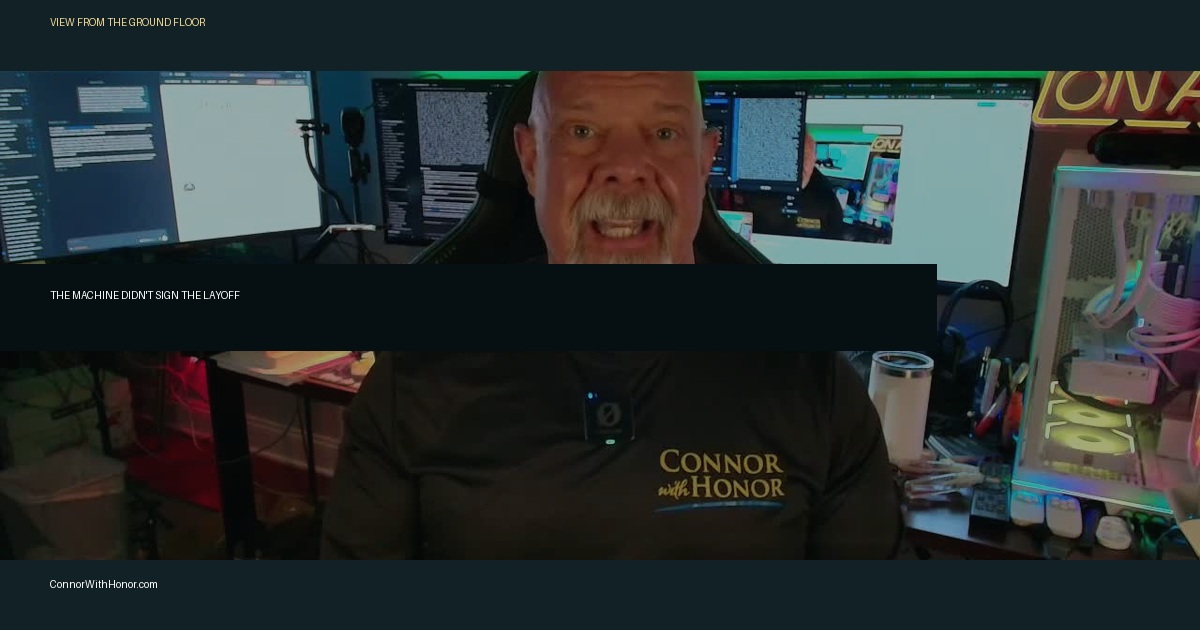
The machine did not sign the layoff. A person did. That is Connor MacIvor's whole point in this Ground Floor episode. AI can do real work. AI can replace tasks. AI can change staffing needs. But when a company decides to cut people, report savings, tell investors a story, and file paperwork, the machine is not the legal actor. People are.
That distinction matters because AI is becoming a convenient shield. Companies can blame the machine when the blame makes them look modern. They can soften an ordinary cost-cutting decision by calling it automation. They can turn a management choice into a force of nature. Connor's police-department analogy is blunt: you do not book the crowbar. You book the person holding it.
This article is not anti-AI. Connor uses AI every day. The point is accountability. A hammer does not decide where to swing. Somebody aims it. If AI is aimed at workers on the ground floor, the signature still belongs to the people at the top.
The First Number
The episode starts with the 2026 layoff context. More than 100,000 announced job cuts in the United States have been attributed to artificial intelligence in public reporting. Some of that may be real. AI is taking over tasks. Companies are redesigning work around models, agents, automation, and software that can do things people used to do manually.
But the number by itself does not tell us whether AI caused every cut. It tells us that AI has become part of the explanation. That is a different claim. A company may cut people because demand softened, because financing changed, because management overhired, because the stock market rewards margin, because the business wants to look AI-first, or because AI genuinely replaced a workflow. Those explanations can overlap.
The public needs better language than "AI did it." If AI replaced a task, say which task. If the company was already shrinking, say that. If the cut was mostly a cost decision dressed in AI language, say that too. Precision matters because workers, investors, customers, and policymakers react differently depending on what actually happened.
That is why this article belongs beside AI Risks: The Chorus Of Crashes. The chorus article asks who pays when a financial story breaks. This article asks who signed the decision when the machine becomes the excuse.
AI Washing
The name for part of the problem is AI washing. A company cuts people to save money, simplify operations, satisfy investors, or respond to a slowdown, then tells the public AI did it. That language can make an ordinary management decision sound like participation in the future.
Analysts at Deutsche Bank have used the phrase AI redundancy washing. Sam Altman has also said there is some AI washing going on. The article does not need to make one CEO the villain. The point is broader. AI has become a powerful story, and powerful stories can be used to cover weaker explanations.
Connor compares it to a seller who says the market made them drop their price. Sometimes the market really did turn. Sometimes the seller simply needed to move. Either way, the market takes the blame. In business, AI can now play the same role. It can be the word that makes a decision sound inevitable.
A useful AI disclosure should separate cause, tool, and justification. Cause asks why the company cut. Tool asks what the AI actually does. Justification asks why the decision was made now and who benefits from the explanation. If those three are mixed together, accountability gets blurry.
The Checkbox Nobody Checked
The New York WARN checkbox is the cleanest fact in the episode. In March 2025, New York added a checkbox to layoff notices asking whether the layoff was due to new technology, including AI. Over the next year, more than 160 companies filed layoff notices, and reporting on that form showed zero checked the AI box.
That does not prove AI had no role in any workforce decision. It proves something narrower and more revealing. Public language and legal-form language can diverge. In the press release, AI can make the company look modern. On the form, where the statement may carry consequences, AI can disappear.
Connor's line is sharp: AI gets the blame when it makes the stock look smart and disappears when it might come with a bill. That sentence should make every worker, investor, and policymaker pause. If a company wants credit for AI savings, it should be willing to name who paid for those savings.
That is not a call for panic. It is a call for symmetrical disclosure. If AI is material enough to mention to Wall Street, it is material enough to explain to Main Street. If the company wants the productivity story, it should also carry the transition story.
The Robot Distraction
The episode then turns to the scary robot story. AI may wake up. AI may come after us. AI may have feelings. Nobody knows where those questions end. One major lab has even created a model-welfare research program because it says it does not know whether advanced AI systems might someday deserve moral consideration.
Connor does not dismiss the question forever. Maybe it matters someday. But he pulls the attention back to the ground floor. Do the people losing their jobs have feelings? Yes. Every single one. That question is answerable today.
This matters because the robot story can crowd out the human story. The public can spend hours arguing about hypothetical machine feelings while real people are trying to understand whether their income, status, schedule, family stability, and future role just changed. The far-future question may be philosophically interesting. The present-tense worker question is morally urgent.
A serious AI transition plan can hold both in the right order. Research safety. Study model behavior. Ask hard questions about future systems. But do not let speculative machine status become a way to dodge the known human cost of decisions already being made.
The Regulatory Moat
Connor also points at the rulemaking fight. Large AI labs go to Washington for rules on their own products. Some people say that is responsible concern. Some people say it creates a moat. A White House AI advisor has accused one major lab of using fear to shape the rules, and the lab denies it. The article keeps both sides unnamed because the pattern matters more than making a named CEO the target.
Connor's building-code analogy is useful. Imagine a large builder asking the city for a stricter code after its tract is already finished. The new code might make homes safer. It might also make it harder for the next small builder to compete. Both things can be true at the same time.
That is how AI regulation should be read from the ground floor. Some rules may be necessary. Some may protect the public. Some may also favor companies that already have the lawyers, compliance teams, capital, compute, and market position to absorb the rule. The question is not rules or no rules. The question is who writes them, who can comply, and who gets locked out.
For the access side of that problem, read The AI Access Gap, Explained Simply. Access and accountability are connected. The people with the most access often have the most ability to shape the explanation.
Who Is Holding The Hammer?
The robot story, the feelings story, and the rule story all put attention on the machine. Connor wants the attention on the hand. AI is a hammer. A hammer does not decide where to swing. Somebody aims it.
That sentence is simple, but it changes the conversation. If a company uses AI to improve response time, the person aiming the hammer should explain the workflow. If a company uses AI to reduce headcount, the person aiming the hammer should explain the transition plan. If a company uses AI to impress investors, the person aiming the hammer should explain what changed for customers and workers.
The hammer frame also protects the good use of AI. A hammer can build. AI can help a small business answer calls, prepare drafts, sort documents, flag issues, summarize records, and serve customers faster. The issue is not the tool. The issue is whether the tool is used to raise human capability or hide human responsibility.
That is why Connor keeps returning to the Transition Moonshot. If AI creates surplus, the surplus should help carry people through the gap. If the tool makes a company more efficient, some of that efficiency should fund training, ownership, role redesign, or a bridge to the next thing. For the constructive frame, read The Transition Moonshot: AI From The Ground Floor.
The Signature Standard
The word Connor asks viewers to hold is signature. Every layoff has a signature. A real person, with a real name, signs the paperwork or approves the decision. The machine may be part of the story, but the machine does not own the decision.
The signature standard is a simple accountability test. If a company tells investors how much AI saved, it should tell workers and the public who it cost. Same day. Same number. Same seriousness. Do not let the company use AI as a spotlight when it wants credit and as fog when accountability arrives.
That standard would improve public language immediately. Instead of "AI reduced headcount," the company would say which process changed, which roles were affected, what support was provided, what savings were expected, what transition bridge exists, and who approved it. That is not anti-business. It is basic stewardship.
The standard also helps investors. If a company cannot explain whether AI savings come from better service, better tools, customer growth, or blunt headcount reduction, investors do not have a clean story either. Vague AI language can hide weak operations as easily as it can describe strong automation.
What Workers Should Ask
Workers should ask what task AI is taking, not only what job title is threatened. A job is a bundle of tasks, judgment, relationships, exceptions, trust, and responsibility. If a company says AI is changing the work, ask which parts are changing and which parts still need human judgment.
Workers should also document the invisible work. What exceptions do you catch? What customer signals do you read? What risk do you prevent before it becomes visible? What knowledge is not in the manual? Those details matter because automation plans often start by reducing work to the visible task.
Finally, workers should ask what bridge exists. Paid training, internal mobility, access to tools, time to learn, severance, placement support, ownership opportunities, or a real runway all matter. A company that says AI made the decision is trying to skip the bridge question.
What Business Owners Should Ask
Business owners should ask whether AI is improving the promise or only lowering the cost. If a tool helps answer more calls, follow up faster, reduce dropped requests, and keep a human route visible, that can be a good deployment. If it only hides from customers or removes people without improving service, the business may be borrowing credibility from AI while weakening trust.
Owners should also keep the review lane clear. Who checks the output? Who handles the sensitive issue? Who is allowed to override the system? What error stops the workflow? What data may the tool see? What customer promise is never delegated?
The best AI owners will not be the ones who blame the machine fastest. They will be the ones who use the machine clearly, document the boundaries, and own the human decision.
The Five-Part Disclosure
A company that wants credit for AI-driven efficiency should be able to give a five-part disclosure. First, what workflow changed? Not the slogan. The workflow. Was it customer support, underwriting, intake, scheduling, coding, quality review, reporting, design, sales follow-up, or something else? The public cannot understand the cost if the task is hidden behind one broad word.
Second, what did the AI actually do? Drafting a response is different from sending a response. Summarizing a file is different from deciding a case. Flagging a risk is different from rejecting a person. A tool that prepares work is not the same as a tool that owns the outcome. Those distinctions decide whether the deployment raises capability or removes accountability.
Third, who reviewed the output before the decision affected a person? A review lane is not decoration. It is where the company proves that someone with authority still owns the promise. If the company cannot name the review lane, the worker and customer are being asked to trust a process that has no visible adult in the room.
Fourth, who was affected and what bridge was offered? If roles were cut, say what support existed before the cut. Paid training, internal transfer time, severance, placement help, tool access, or a funded runway are not the same thing as a sentence in a memo. The bridge has to be real enough for a person to stand on it.
Fifth, who signed the decision? That does not mean one person must be publicly attacked. It means the company should not pretend the decision had no human owner. The signature can be a role, a committee, a board approval, or an executive certification. The point is that the machine did not wake up and choose a headcount plan.
Those five questions would make AI washing harder. They would not block useful automation. They would make useful automation cleaner because the company would have to describe what changed, what worked, what remained human, and what support existed for the people who carried the transition.
The Investor Version
Investors should want this standard too. Vague AI language can inflate a weak business story. If a company claims margin improvement from AI, investors need to know whether that margin came from a durable process improvement or from a one-time cut that weakens service, culture, or future capability. The first can be a real advantage. The second can be a delayed liability.
A clean investor question would be: what did AI make better that customers can feel? Faster response time is useful if the answer is correct. Lower cost is useful if quality and trust hold. More output is useful if the output serves a real customer and does not create a correction backlog. AI savings that break the customer promise are not strong savings.
Another investor question is: what knowledge left the building? When experienced people are removed, the company may also lose exception handling, customer memory, training capacity, and informal risk detection. If AI was trained on the work but the people who understood the edge cases are gone, the company may have converted living judgment into a static process without realizing what it lost.
That is why accountability protects good AI companies. Strong operators should welcome clearer language because it separates real deployment from costume. If the tool works, show the workflow. If the savings are durable, show the customer result. If the people were supported, show the bridge. A weak operator hides behind the machine. A strong operator can sign the story.
The Customer Version
Customers should also ask who is holding the hammer. If a company moves service into an AI channel, can the customer reach a human when the issue is emotional, expensive, urgent, or unusual? Can the customer appeal a wrong answer? Can the customer see whether the answer came from policy, a model, a worker, or a script?
A customer does not need to know every internal detail. The customer does need a visible route to responsibility. If AI makes a service faster but makes responsibility harder to find, the customer has lost something. If AI makes a service faster and the human route remains clear, the customer may have gained something.
This is the same standard Connor uses for business AI. Let the tool handle bounded work. Let it draft, summarize, route, and prepare. Keep the promise owned by a person. The public can accept automation when accountability is clear. The public loses trust when the company uses automation as a locked door.
The Policy Version
Policymakers do not need to ban every AI layoff to improve the situation. They can start by making the disclosure cleaner. If a layoff is attributed to AI in public messaging, the company should explain whether that means task automation, demand decline, restructuring, vendor consolidation, offshoring, ordinary cost reduction, or some combination.
A better form could ask for the workflow affected, the approximate number of roles affected, whether affected workers were offered paid training or internal transfer windows, and whether any public AI-savings claim was made to investors. That would not solve the whole transition. It would make the signature harder to hide.
The New York checkbox shows how much room there is between public language and legal language. The next version should close that room. If companies want the public-relations benefit of saying AI made them efficient, they should also carry the public-record responsibility of saying what AI changed.
That kind of disclosure would help workers, investors, customers, and serious builders. It would also help the AI industry by separating real deployment from AI washing. If the transition is going to be hard, the least we can do is stop letting the hardest parts hide behind a machine that cannot sign its name.
The Ground Floor Rule
The ground-floor rule is simple. Do not let a machine story erase a human signature. If AI is the tool, say what the tool did. If a person aimed it, say who made the decision. If workers carry the cost, say how the transition is funded. If investors hear the savings number, workers deserve the cost number too.
That rule lets Connor stay both pro-tool and pro-human. AI can help. AI can build. AI can make small businesses more capable. But the moment AI becomes a mask for avoiding responsibility, the ground floor should ask for the signature.
The machine did not sign the layoff. The people who did should stop hiding behind it.