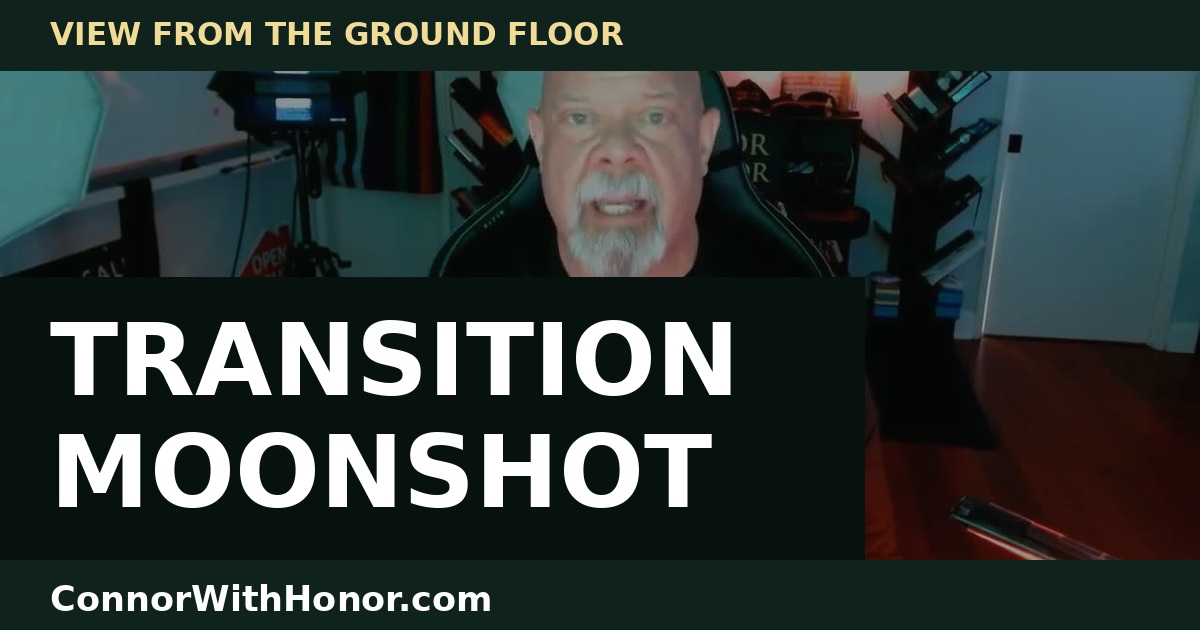
Connor MacIvor's October 8 LIVE starts with a simple discomfort: the AI transition is being discussed from the top while the cost is being felt from the ground floor. The people told to adapt are often the last people invited to define what a good transition would even mean.
That is why this episode proposes a different kind of Moonshot. Not a new prize built around who can make the largest model, automate the most jobs, or produce the flashiest demo. A transition Moonshot would ask whether workers, small businesses, operators, and families actually become more capable while the tools get stronger.
The point is not to attack AI. Connor's argument is sharper than that. AI can be useful, powerful, and inevitable in many workflows. The question is whether the transition is being designed for humans or merely announced to them after the economic plan is already in motion.
That distinction matters because a technology transition can be real and still be poorly managed. It can create new jobs and still displace people. It can help one business grow while another business loses the customer relationship that made it valuable. It can make a person faster at work, or it can make that person's work easier to separate from the person.
What A Moonshot Means Here
Moonshot language has a history. Peter Diamandis founded XPRIZE, and the Ansari XPRIZE helped prove that a clear prize can pull ambitious teams toward a measurable goal. That space prize launched in the 1990s and concluded in 2004 when SpaceShipOne completed the qualifying flights. Later XPRIZE efforts moved into other hard problems, including ocean health, seafloor discovery, and carbon removal.
That history is useful because it shows the pattern. A good prize does not only say "innovation would be nice." It defines the target, names the measurement, makes the goal public, and forces teams to show results. It turns aspiration into a contest that can be judged.
The fact gate matters here. This article is not claiming Connor has a partnership with XPRIZE, Moonshots, or Peter Diamandis. It is also not repeating every shorthand that appears in casual conversation. The verified frame is broader and cleaner: prize-driven Moonshot thinking has been used for space, ocean challenges, and carbon removal. Connor is borrowing the operating idea, not claiming an affiliation.
The operating idea is strong enough on its own. If we can create prizes for rockets, sensors, mapping, and carbon removal, we can at least imagine a public challenge for the AI transition itself. The goal would not be to stop AI. The goal would be to prove that AI adoption can make ordinary people more capable instead of merely making labor easier to cut.
That is the first shift. Most AI contests reward technical capability. A transition Moonshot would reward human capability after deployment. Did the worker earn more leverage? Did the small business keep more customers? Did the team reduce drudgery without hollowing out judgment? Did the company document what changed, who benefited, who was hurt, and what the next correction should be?
Uncomfortable For Who?
One of the strongest questions in the episode is Connor's pause on the word uncomfortable. People with capital, platforms, and model access can say a transition will be uncomfortable with a kind of distance. The people on the ground floor hear that sentence differently. They hear rent, mortgage payments, medical bills, kids, groceries, training time, and the fear that the job they learned will be broken into tasks and redistributed through software.
That does not make every automation cruel. It does make the burden specific. A transition is not an abstraction to the person whose department is being measured against a model. It is not an abstraction to the dispatcher who sees an AI phone agent handle the first call. It is not an abstraction to the assistant who trains the workflow that will later be used to ask whether the assistant is still needed.
The current public jobs research supports that tension. The World Economic Forum's 2025 jobs report projects both creation and displacement by 2030, with a large net gain and a large amount of churn. International labor research also keeps separating exposure from automatic replacement, because many jobs are changed by AI before they are fully replaced. That distinction is important, but it is not comfort by itself.
A net gain does not pay the bill for the person on the wrong side of the displacement. A new job category does not automatically retrain the person whose current role was optimized away. A company-level efficiency gain does not prove that the customer experience, community, or employee skill base got healthier.
That is why Connor's question works. "Uncomfortable for who?" forces the discussion to name the person carrying the transition. If the answer is always someone else, the plan is incomplete.
AI As A Hammer
Connor uses a tool image that is easy to understand. AI can be a hammer. A hammer can build. A hammer can also break. The moral value is not in the hammer by itself. It is in the purpose, the hand using it, the structure being built, and the consequences of swinging it without a plan.
That is a better frame than asking whether AI is good or bad. The tool is already here. The better question is where it belongs in the workflow. What should it draft? What should it summarize? What can it classify? What may it never send without review? What should it not see at all? Who is accountable when the output turns into a promise?
Those questions are not anti-innovation. They are the difference between a demo and a system. A demo shows what the tool can do once. A system defines what the tool is allowed to do every day, under pressure, with real customers and real consequences.
The hammer frame also protects workers from the wrong lesson. The point is not that people should race against every task forever. If AI can take repetitive work, let it take repetitive work with the right boundaries. The point is that people need to move toward the judgment around the work: the exceptions, the customer promise, the review standard, the outcome measurement, and the accountability that still needs a human owner.
That is where small businesses have an advantage. A large company may automate first and clean up later. A smaller operator can map the workflow before the tool touches it. The owner can decide the allowed data, the review lane, the stop condition, and the customer promise while the system is still small enough to understand.
What Would The Prize Measure?
A transition Moonshot should not reward the team that fires the most people with the cleanest spreadsheet. That is the lazy version of AI efficiency. A serious prize would need better measurements.
The first measurement should be capability. Did the people closest to the work become more capable after AI was introduced? Can they solve more valuable problems? Can they serve more customers without losing quality? Can they explain the system, challenge it, and improve it?
The second measurement should be income and security. Did the transition create a path for workers to earn more, own more responsibility, or move into higher-leverage roles? If the company saved money, did any of that value translate into training, stability, or advancement for the people who helped make the system work?
The third measurement should be customer trust. Did response time improve while complaints stayed low? Did customers understand when they were dealing with automation? Did the company preserve a clear human route for sensitive, expensive, or emotional situations?
The fourth measurement should be error handling. Every AI system fails. A prize-worthy transition would not pretend otherwise. It would record failures, route edge cases, protect private data, and improve the workflow without hiding the mess from the people affected by it.
The fifth measurement should be transferability. Can the lesson help another small business, department, or community without copying private data or pretending every workplace is the same? A good transition model should be teachable. It should show the method, the limits, and the evidence.
That kind of prize would change the public conversation. Instead of asking only which model performs best on a benchmark, it would ask which deployment improved the lives and leverage of the people working with it.
The Ground Floor Is Where Reality Shows Up
The ground floor is not a sentimental phrase here. It is where the process touches reality. It is the call that comes in after hours. It is the employee who knows which customer is anxious and which customer is angry. It is the real estate assistant who knows the listing detail that never makes it into the template. It is the operator who sees the exception before the spreadsheet does.
AI systems often struggle because the people designing them do not understand that hidden layer. They see the visible task. They miss the judgment inside the task. They automate the motion and accidentally remove the part that made the motion useful.
This is where Connor's work stays practical. He keeps asking for one real workflow. Not a vague fear. Not a fantasy app. One process that eats time, loses leads, creates mistakes, frustrates customers, or depends on a person remembering every step.
The workflow is the unit of progress. Once the workflow is visible, AI can be tested without turning the whole business into an experiment. The owner can write down the input, the permitted output, the review owner, the stop condition, and the success measure. That makes the system safer and more useful at the same time.
A transition Moonshot should collect these workflow stories. It should reward teams that make the ordinary process better while keeping human accountability visible. That may not sound as dramatic as a rocket flight, but it is exactly where the AI transition will be judged by most people.
What Leaders Should Stop Saying
Leaders should stop saying the transition will be uncomfortable as if that sentence completes the thought. It does not. If the transition is uncomfortable, name the people affected, the support offered, the measurement used, and the point at which the plan will be corrected.
They should also stop treating workers as an afterthought in the product plan. The people closest to the work often know where automation will fail. They know which exception matters. They know which customer cannot be handled by a script. They know which step is repetitive and which step looks repetitive only to someone who has never done it.
They should stop equating adoption with success. A company can adopt AI everywhere and still become less trusted. A team can automate more tasks and still frustrate customers. A manager can celebrate lower labor cost while quietly damaging the relationship that produced the revenue.
The better language is specific. We are automating this task. This person owns review. This data is allowed. This data is not allowed. This result would count as improvement. This failure would stop the pilot. This is how workers share in the upside if the system works.
That is not slower leadership. That is adult leadership. It is how a company moves quickly without making people pay for every unknown.
What Workers Should Start Mapping
Workers should not wait for someone else to define their role as a collection of replaceable tasks. Start mapping the work now. Write down what you do, what you decide, what you notice, what you refuse, and what breaks when the work is rushed.
The visible task is only part of the job. The stronger map includes context. Which customers need extra care? Which requests sound simple but carry risk? Which exceptions save money later? Which reports are read by humans, and which are only theater? Which steps could AI help with tomorrow, and which steps require a person who understands the consequence?
That map becomes leverage. It helps the worker learn the system around the task instead of defending every old motion. It also helps the owner see the value that may be lost if automation is deployed blindly.
A practical worker map can be five columns: task, input, judgment, risk, and owner. The task is the visible activity. The input is the information needed. The judgment is what a capable person knows that is not obvious. The risk is what happens if the work is wrong. The owner is who remains accountable.
Once that map exists, AI becomes less mystical. Some tasks can be drafted. Some can be summarized. Some can be routed. Some should remain human-led. The map turns fear into decisions.
What Small Businesses Can Do This Week
Pick one workflow. Missed calls, new lead follow-up, appointment reminders, review requests, document summaries, content drafts, quote preparation, customer intake, internal reporting, or post-sale follow-up are all candidates. Choose one that is real enough to matter and narrow enough to test.
Write the current process before adding AI. How does the request arrive? Who sees it? What happens first? What information is needed? What answer is allowed? What requires a human? What counts as done?
Then decide what AI may do. It might summarize the call. It might draft the reply. It might classify the request. It might prepare the next step for a human. It might watch for missing information. Keep the first test boring. Boring tests are easier to verify.
Measure the result. Did speed improve? Did quality hold? Did customers respond better? Did the team trust the workflow? Did the system create new review burden? Did any private information move somewhere it should not have moved?
If the result is good, expand carefully. If the result is bad, record why. Failure is not embarrassing when it is caught in a small pilot. Failure becomes expensive when a company lets a polished demo skip the review lane.
The Fact Gate For Big Claims
A transition Moonshot also needs a fact gate because big AI claims travel faster than careful language. This episode uses public prize history and public labor forecasts as context, but the public copy has to keep those claims in the right lane. Prize history shows that ambitious goals can be measured. Jobs research shows that the AI transition can create and displace work at the same time. Neither fact proves that a specific company, worker, or customer will experience the transition in the same way.
That is why the article separates fact, inference, and recommendation. The fact is that prize models have been used for hard technical and scientific goals. The inference is that a similar measurement culture could be useful for the AI transition. The recommendation is to design one around human capability, not only around technical output.
The same discipline applies to job numbers. A report can project large job creation and large job displacement by 2030. That is useful context. It does not tell a dispatcher, assistant, analyst, agent, loan officer, driver, or small business owner exactly what will happen next month. The responsible move is to use the forecast as a warning to map the work, not as a script for panic or comfort.
This is also why the article avoids pretending that "AI transition" means one thing. In one workplace it may mean a voice agent that catches missed calls. In another it may mean a research assistant. In another it may mean layoffs. In another it may mean a small team finally serving customers after hours without burning out. The same tool category can produce different outcomes depending on design, incentives, review, and who shares in the upside.
A serious Moonshot would publish those differences instead of hiding them in marketing language. It would ask for baseline data before the rollout. It would ask what changed after the rollout. It would ask which people gained skill, income, time, safety, or access. It would also ask who lost leverage, who had to retrain, who absorbed extra review work, and who got no say in the decision.
That is not negativity. It is measurement. A prize that only rewards the clean success story will train teams to hide the cost. A prize that rewards the full transition record will train teams to solve the harder problem: making the future work better for the people who have to operate inside it.
Where The Episode Fits
This episode belongs beside Connor's broader AI argument. In AI Broke Math. The Review System Broke First., the issue was review speed. In AI Replacement Has a Buyer Problem., the issue was whether an economy still works when too many people are optimized out of the buyer base. In AI Can Help. You Still Need to Be in Control., the issue was keeping human authority visible.
This piece adds the transition frame. If AI is going to change work at the ground floor, then the transition itself deserves a measurement system. Do not only ask what the model can do. Ask what happened to the people and businesses after it was installed.
For implementation thinking, read Can AI Agents Find and Understand Your Business? and An AI Idea Is A Starting Point. Your Business Playbook Is The Difference. Those pieces connect the big question to the daily operating work.
You can also listen to the podcast version of this episode here: The Transition Moonshot: AI From The Ground Floor.
The Real Challenge
The real challenge is not whether AI becomes stronger. It will. The real challenge is whether people become stronger with it, or whether they become easier to measure, replace, and ignore.
A ground-floor Moonshot would make that question public. It would reward the teams that show their work, improve capability, protect trust, and prove that automation can expand human leverage instead of quietly extracting it.
That is the invitation in this LIVE. Do not wait for the transition to be explained after the fact. Map the work. Name the risk. Build the review lane. Measure what happens to the people. Then bring one real workflow to Book With Honor if you want help turning AI from a novelty into a working system with a human owner still in the loop.