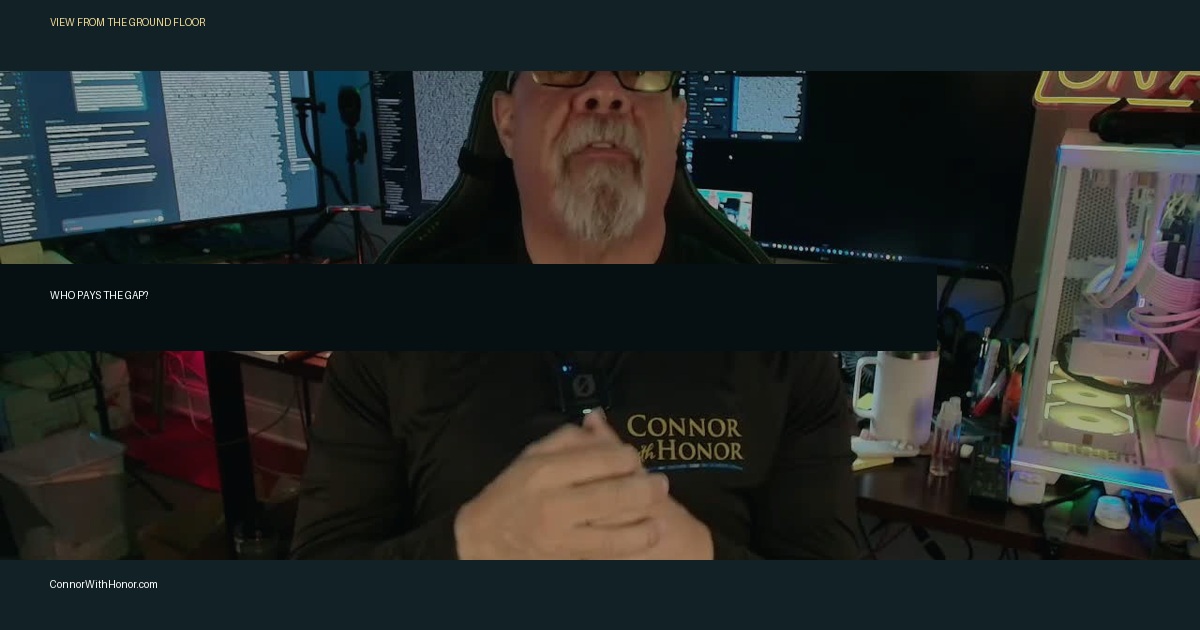
AI has already won the argument that it can do real work. The harder question is who pays during the years between the breakthrough and the payoff. Connor MacIvor's October 8 pilot puts that gap in the center of the frame: the model gets stronger, the owner gets a new tool, investors get a story, but the worker, the small business, and the customer often carry the transition before the reward reaches them.
This is not an anti-AI episode. Connor builds with AI every day. He uses it for production, research, workflow design, content operations, and the practical work of making small businesses more capable. The point is sharper than "AI bad" or "AI good." The point is that a tool can be useful and still move cost onto people who did not get to vote on the rollout.
That is why the final cut removes the fact-risky middle section from the raw pilot. The written record can keep the useful argument without keeping every live-room shortcut. The corrected version is simple: every major technology transition creates a gap between invention and broadly shared benefit. Early capital usually gets paid first. Operators and workers often pay in stress, retraining, lower bargaining power, or lost time. A serious AI transition plan has to name that gap instead of hiding it under excitement.
The Gap Is The Story
Most AI coverage rewards the announcement. A new model ships. A benchmark falls. A company shows a demo. Somebody says a whole job category is finished. Somebody else says the new jobs will be better. The missing chapter is the time between those two claims.
That time is the gap. It is the season when the new tool is powerful enough to disrupt the old work but not yet organized enough to make the next work stable. It is when a manager asks what can be automated before the company has mapped what should be protected. It is when a worker is told to learn the future while still paying today's bills. It is when a small business owner knows AI matters but does not know which vendor, workflow, data rule, or customer promise will survive contact with reality.
The gap is also where bad language does damage. "Everyone will have to adapt" sounds harmless from a keynote stage. On the ground floor, it means training time, lost leverage, a smaller paycheck, a new surveillance layer, or the quiet fear that the task you are documenting today may be used to remove you tomorrow. A transition can be necessary and still be unfairly financed.
Connor's question is not whether AI should exist. It exists. His question is whether the transition can be designed like a serious public project instead of being left to a pile of private layoffs, vague optimism, and after-the-fact retraining slogans. That is where the Transition Moonshot idea begins.
Early Money Gets Paid First
The pilot uses a plain distinction: early money and late money do not live in the same world. Early money gets risk, access, and the first claim on upside. Late money often gets the marketing deck after the story has already been priced. In technology transitions, the same pattern shows up outside the stock market. People with capital and infrastructure can move early. People whose income depends on one role or one business process absorb the shock later.
That does not make early capital evil. Risk capital funds experiments that may fail. But the social story usually gets told as if everybody is entering the new era from the same starting line. They are not. The person deploying automation, the person being measured against automation, and the person whose customer relationship gets mediated by automation are standing in different places.
That matters for AI because the technology is not limited to one sector. It can touch phone calls, sales follow-up, code, design, legal triage, tutoring, logistics, scheduling, hiring, health intake, real estate workflows, marketing, content, finance, and management reporting. The same tool class can raise output in one room and reduce headcount in another. It can make one operator look brilliant while making another person's work easier to separate from the person.
If the public conversation only celebrates the first room, the second room becomes invisible. A transition plan that does not name the second room is not a transition plan. It is a productivity plan with the human cost pushed off the spreadsheet.
History Keeps Showing The Pattern
History does not repeat neatly, but it does leave fingerprints. The Panic of 1873 began around railroad finance and Jay Cooke's connection to Northern Pacific. Jay Cooke & Co. failed on September 18, 1873. Trading on the New York Stock Exchange stopped for ten days. Thousands of businesses failed in the depression that followed. The railroad itself was real infrastructure, but the financing boom, the fragile confidence, and the collapse were paid for by far more people than the financiers who promoted the story.
That is the lesson Connor is reaching for. A breakthrough can be real while the rollout still damages people. Railroads changed the country. They also created speculative excess, overbuilding, labor conflict, and a crash that moved pain far beyond the people who designed the securities.
The dot-com era carries a similar warning. The internet was not fake. It was one of the most important infrastructure transitions of modern life. But the market around it became unstable. The Nasdaq Composite closed at 5,048.62 on March 10, 2000, then fell roughly 77 percent by October 2002. Trillions in market value disappeared. Many companies that had promised the future did not survive long enough to build it.
Lockups, insider timing, and public enthusiasm all shaped the gap between early and late participation. In early 2000, many large blocks of newly public shares were approaching release from lockup restrictions. The important point for this episode is not a courtroom claim about one executive. The point is the pattern: early participants often have ways to exit, hedge, or reposition before ordinary workers and late buyers understand the full cost of the transition.
Global Crossing is a clean caution without turning the article into a trial. The company built a vast fiber-optic network and filed for bankruptcy protection in January 2002. Some telecom capacity was ahead of demand. Some of the infrastructure later became useful. That does not erase what happened during the gap: investors lost money, employees lost jobs, and the promise of a connected future did not pay everyone in the order the sales story suggested.
The careful sentence is this: the internet won, but not everyone who paid for the transition got carried safely across it. That is the AI question too. If AI wins, who gets carried across the gap, and who is told the gap was just the price of progress?
The Productivity Gap Has A Name
Economists use the phrase Engels' pause for part of the British Industrial Revolution, when output grew faster than workers' real wages. The common shorthand is that from about 1780 to 1840, output per worker rose substantially while real wages moved much less. The numbers often cited are about 46 percent for output per worker and about 12 percent for real wages over that period.
That does not mean the Industrial Revolution failed. It means the benefits did not arrive evenly or instantly. Machines, factories, and new production systems changed what society could make. Workers did not automatically receive the gains at the same speed. The productivity line and the wage line separated, and people lived inside that separation.
AI could create a modern version of that pause. A company may produce more with fewer people. A worker may be asked to handle more because the model handles the first draft. A manager may believe productivity improved because output increased, even if wages, security, training, and quality of life did not improve for the people doing the work.
That is why the Transition Moonshot cannot measure only model performance. A benchmark can tell us whether a model got better. It cannot tell us whether the cashier, assistant, dispatcher, designer, analyst, customer service worker, real estate coordinator, or small business owner became more secure. The human side needs its own measurement, not as decoration but as the main target.
When A Gap Becomes Despair
The editorial notes for this episode also point to Case and Deaton's 2015 PNAS paper on rising midlife mortality among white non-Hispanic Americans. Their work connected increasing mortality to drug and alcohol poisonings, suicide, and chronic liver disease and cirrhosis. The article should not turn that into a lawyer story or a simple one-cause explanation. It is a warning about what happens when economic and social dislocation becomes personal collapse.
That warning belongs in an AI transition article because work is not only a paycheck. Work carries status, routine, identity, relationships, confidence, and a sense that tomorrow can be shaped by effort. When a community loses that structure, the cost is not captured by a spreadsheet showing lower labor expense.
AI will not automatically create that kind of despair. It also will not automatically avoid it. The result depends on choices. Do companies treat workers as partners in redesigning the work, or as temporary training data? Do small businesses use AI to serve customers better, or to hide from them? Do policymakers measure displacement early, or wait for the damage to appear in health, housing, addiction, family stress, and local decline?
A serious transition plan asks those questions before the pain becomes a statistic. It does not wait until the wreckage is obvious and then call it the unavoidable cost of innovation.
The Hopeful Part Is Also Historical
The episode is not only a warning. The hopeful half is that societies have built bridges across transition gaps before. The Federal Deposit Insurance Corporation came out of the banking crisis era through the Banking Act of 1933. The Fair Labor Standards Act became law in 1938 and set national wage and hour standards. The GI Bill helped millions of World War II veterans move into education, training, housing, and civilian opportunity after the war.
None of those programs was perfect. Each one came from conflict, politics, and the constraints of its time. But they show a pattern that matters. When a society recognizes that a transition is too big to leave to individual luck, it can build institutions that make the next chapter more stable.
That is the spirit of the Transition Moonshot. It is not a request for everyone to fear AI. It is a demand that the transition itself become a design problem. If we can measure model speed, compute cost, reasoning accuracy, and market cap, we can measure whether workers and small businesses are actually gaining capability. If we can fund technical races, we can fund deployment races that reward human upside.
The Ansari XPRIZE is useful as a model because it put a measurable challenge in public and paid the winner only after the goal was reached. The lesson is not to borrow the brand or pretend there is a partnership. The lesson is to define a target that can be judged. For AI, the target should not be "replace the most labor." It should be "prove that people closest to the work become more capable, better supported, and more able to own the future."
Hammer, Not Ring
Connor's cleanest practical frame is that AI should be used like a hammer, not worn like a ring. A hammer is a tool. You pick it up, use it for a purpose, and put it down when the job requires something else. A ring becomes identity. It can turn the tool into a symbol of belonging, status, or surrender.
That distinction matters because a lot of AI adoption is being sold as identity. Be an AI company. Become AI-first. Replace your old way of thinking. Move faster than the people asking questions. The problem is that identity language can make weak deployments look brave. It can pressure teams to automate before they understand the work.
AI as a hammer asks better questions. What are we building? What material are we touching? What damage could we do if we swing too hard? Who knows how this structure is supposed to hold weight? Who checks the work before someone lives inside it?
That is how a small business should start. Pick one workflow. Missed calls. Lead follow-up. Appointment reminders. Document intake. FAQ triage. Listing prep. Content repurposing. Customer review requests. Build a bounded lane. Decide what data the AI may see, what it may draft, what it may never send, who reviews, what result counts, and what failure stops the pilot.
For more on keeping control while using AI, read AI Can Help. You Still Need to Be in Control. For the business playbook side, read An AI Idea Is A Starting Point. Your Business Playbook Is The Difference.
Three Questions For Every Forecast
The pilot gives viewers a simple filter for the next wave of AI predictions. The first question is who gets paid early. If the answer is founders, investors, vendors, and platform owners, say that clearly. That does not invalidate the product, but it tells you whose upside is already organized.
The second question is who pays during the gap. Does the worker pay with a vanished role? Does the customer pay with a worse service layer? Does the owner pay with vendor lock-in? Does the community pay with fewer stable jobs? Does the young person pay with a career ladder that lost its first rung?
The third question is what bridge exists. Training is not a bridge if nobody has time to take it. A new job category is not a bridge if the displaced worker cannot realistically reach it. A productivity gain is not a bridge if the gains never fund stability, education, ownership, or better work.
Those questions keep the conversation from floating away. They also keep AI optimism grounded. The right answer is not to reject every forecast. The right answer is to ask whether the forecast includes a credible path for the people who have to live through it.
What A Transition Moonshot Could Reward
A useful Transition Moonshot would reward deployments that prove human capability increased. It would ask for evidence that people closest to the work can do more valuable work after AI enters the workflow. It would not accept a headcount reduction as proof by itself.
The prize could measure whether workers retained income while moving into higher-leverage responsibilities. It could measure whether small businesses improved response time without lowering trust. It could measure whether customers had a clear human route when the issue became sensitive, expensive, or emotional. It could measure whether errors were logged and corrected instead of buried under polished language.
It could also reward transferability. A deployment that works only because one large company has a private data empire may not help the ground floor. A deployment that shows a repeatable method for a local business, school, clinic, brokerage, nonprofit, or city department could matter much more.
The prize should require before-and-after evidence. What was the workflow before AI? How long did it take? Where did errors occur? Who was overloaded? What changed after deployment? Who reviewed the output? Did customers notice? Did worker skill increase? Did the team keep a kill switch? Did the gains fund training or stability?
That kind of measurement would change the incentive. Teams would stop trying to prove they can erase people from a process. They would try to prove they can raise the capability of people inside a process. That is a different future.
The Sibling Idea: From The Ground Floor
This pilot belongs next to Connor's same-day essay, The Transition Moonshot: AI From The Ground Floor. That companion piece frames the Moonshot from the operator side: start where the work actually happens, not where the keynote sounds cleanest.
The "who pays the gap" pilot adds the economic pressure. It asks who absorbs the years when the technology is real but the benefit is uneven. Together, the two pieces make one argument: AI adoption should be measured by whether ordinary people become more capable, not only by whether the strongest companies become more efficient.
That is why the archive matters. A fast clip can open the door, but the written article can hold the distinctions. It can say railroads were real and the 1873 crash was real. It can say the internet was real and the dot-com crash was real. It can say AI is real and still ask who is financing the disorder between discovery and durable benefit.
For Owners, Workers, And Builders
If you own a business, do not start with the fantasy that AI will fix the whole company. Start with one process that already hurts. Write down the task, the input, the risk, the reviewer, and the outcome. Then decide where AI belongs. If the workflow touches money, private data, health, legal risk, hiring, housing, or a public promise, keep a human review lane visible.
If you are a worker, map the judgment inside your job before someone reduces the job to visible tasks. Write down the exceptions you handle, the customer signals you notice, the risks you prevent, and the decisions that are not obvious from the outside. That map is leverage. It helps you train, defend, redesign, or move into the part of the work that the tool should not own alone.
If you are building with AI, do not call the pilot successful because the demo looked good once. Show the receipts. Show the before-and-after. Show the failure log. Show how people appeal, override, correct, and learn. Show whether the savings created any human upside.
If you are making policy, stop treating retraining as a magic word. Ask who has time, money, childcare, transportation, broadband, health, confidence, and local opportunity to use the training. A bridge that only works for people who are already safe is not a bridge across the gap.
Connor's angle is practical because it refuses both fantasy and despair. AI is not going away. That does not mean the people closest to the work should quietly absorb every cost. The work now is to design the transition with evidence, boundaries, and human capability as the target.
The Closing Standard
The final standard is simple. AI should make people more capable. If a deployment makes a company faster while workers lose leverage, customers lose trust, and owners lose control of the promise, that is not a clean win. It is a transfer of cost.
A good AI transition should be able to answer four questions in public. Who benefits first? Who pays during the gap? What bridge exists for the people at risk? What evidence proves the bridge works?
The technology may be inevitable in many places. The shape of the transition is not inevitable. We can choose to measure the part that matters. We can choose to reward systems that raise human capability. We can choose to keep the hammer in the hand instead of turning it into a ring.
That is the work of the Transition Moonshot. Not a slogan. Not a partnership claim. Not a fear campaign. A measurable demand that the AI era be judged by what happens to the people who have to cross the gap.
For the workforce angle, read AI Job Loss Does Not Have To Happen. For a newer buyer-side version of the problem, read AI Replacement Has a Buyer Problem. For Connor's broader AI archive, start at the Connor with Honor archive.